Senior Nasra Shube said she didn’t think she was going to make it this far in her college journey.
“Somebody did tell me [that] once you make it past your second year, you’re kind of there – you’re on the path to graduating,” said Shube, a senior double-majoring in management and marketing.
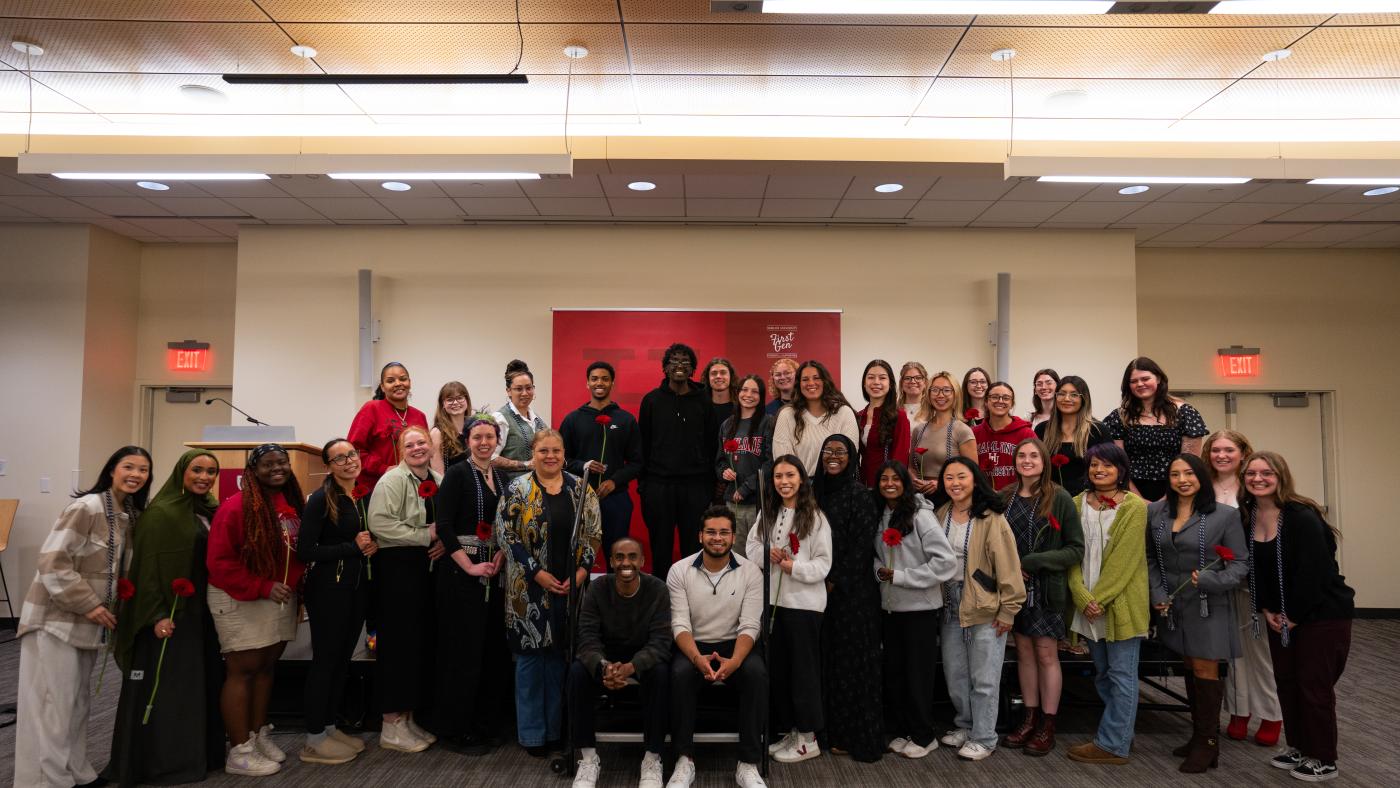
Shube is among 140 graduating seniors who are the first in their families to earn a four-year degree. For 13 years, Hamline has recognized these students at an annual reception and pinning ceremony. This year’s event, on April 28, brought together graduating seniors to receive pins for commencement. Members of Alpha Alpha Alpha, the first-generation honor society, also received honor cords.
“At Hamline University, we are fortunate to have several entities focused on the experiences of first-generation college students,” said Carlos Sneed, associate vice president of student affairs.
The event serves as a celebration and acknowledgement of the determination it takes to be the first in one's family to earn a bachelor's degree.
“Events like this, as well as the other community-building, networking, academic and career events that departments and student organizations sponsor to support and advance the goals of first generation students are so important in helping translate the college terrain to students,” Sneed said.
Fenani Ahmed, a legal studies major with a minor in business practice, arrived at Hamline with a plan to pursue a career in law and graduate early.
“I came to college and I told myself that I would graduate in two years and I actually did it,” Ahmed said.
That accelerated timeline required careful planning and constant self-advocacy. Without family members who had gone through college, Ahmed said she often had to figure out the academic systems on her own, relying on persistence and trial and error to get answers.
“I had to go out of my way to email like 50 different people just to get one answer,” she said. “And I was like, ‘Wow, I really am alone and I have to figure it out.’”
Ahmed said that experience taught her the importance of seeking support early and consistently. She frequently used resources through the Center for Academic Success and Achievement (CASA) and built relationships with faculty and staff, including her independent study professor, who helped her navigate advising changes and provided guidance.
Looking back, Ahmed said she wishes she had used campus resources earlier.
“Being able to use those resources and check in at least once a semester is actually very helpful,” Ahmed said.
Like Ahmed, Shube also found herself leaning on campus resources to navigate college. Her experience was shaped by balancing work, finances and family expectations.
“When you're first-gen, you're not really told how to do something or where to go to find something,” Shube said. “You just got to figure it out.”
She said being first-generation – and being the oldest sibling in the family – gave her a strong sense of purpose. She saw it as an opportunity to represent her family and show her siblings what’s possible.
“Even from our background and where we came from, it shouldn't hold us back,” Shube said.
Born in a refugee camp and raised in a family unfamiliar with college processes, Shube said she found support through programs such as HU Pathways and through connections with other first-generation students.
“It gave me a little bit of community – getting to meet other students who are first-gen and going through the same things I was,” Shube said.
Throughout college, Shube worked two jobs while balancing classes and being involved on campus. In her junior year, she studied abroad in the Netherlands, an experience she never thought possible.
“Whether it was academically or socially, I just would have never thought that I would come this far,” she said.
Ahmed and Shube said their time at Hamline taught them how to build their own paths while learning to ask for help along the way.
“No one has anything figured out. Take that risk,” Shube said. “As a first-generation student, you should really not doubt yourself.”