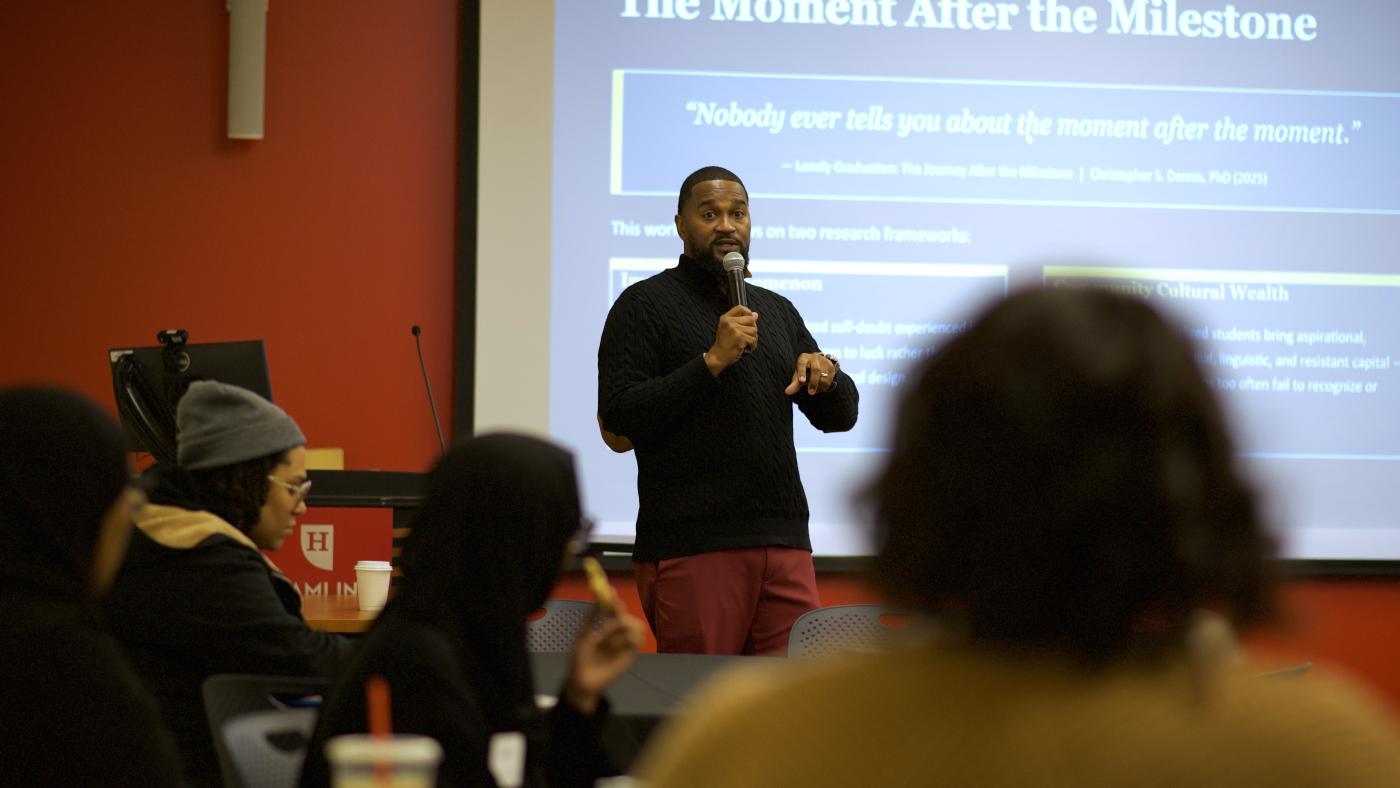
So you’ve been accepted into college. Now what?
“Nobody ever tells you about the moment after the moment,” said educational leader Christopher S. Dennis, Ph.D., founder of the Campus Culture Group. Dennis addressed first-generation and non-traditional students during a March 26 lunch-and-learn lecture workshop, “Beyond the Finish Line: The hidden curriculum, imposter syndrome, belonging and becoming.”
Dennis, an author and speaker with over 18 years of leadership experience, shared strategies for overcoming imposter syndrome and navigating the “hidden curriculum” of higher education. His talk focused on practical ways students can succeed despite systemic barriers.
Understanding imposter syndrome
Imposter syndrome is the internalized self-doubt and fear of being exposed as a fraud. It’s often experienced by high achievers, who attribute their success to luck rather than ability. Dennis said exclusionary systems can amplify these feelings.
“If you made it into a room, you’re a high achiever and you may not realize that you are special,” he said. “You may try to turn that down a bit.”
Dennis described five common patterns of imposter syndrome:
- Perfectionist: The feeling of nothing is ever good enough.
- Superhero: The feeling of doing everything perfectly.
- The expert: The feeling of needing to know everything before taking action.
- The natural genius: The feeling that success should come effortless and struggle feels like failure.
- The soloist: Avoiding help and insisting on handling everything alone.
Students responded to the patterns, sharing how they related to types like “perfectionist” or “expert,” illustrating how common imposter feelings are.
The “hidden curriculum”
Dennis also discussed the “hidden curriculum,” the unspoken rules and expectations that shape success in college. Examples included understanding office hours, navigating academic appeals, learning networking etiquette and connecting to campus resources.
“What if the barrier or the problem that you're facing actually isn't you, what if it's systemic?” he said. “Imposter syndrome makes you think the problem is inside you, but the imposter phenomenon recognizes external patterns. Sometimes it’s the system making you feel that way.”
He added that institutions often reward extroverted, high-achieving students who fit certain molds, which can unintentionally leave others feeling undervalued. Dennis encouraged students to share their experience with peers.
“You don't have to gatekeep the information that you have,” he said.
Navigating systematic access
First-generation and non-traditional students often enter college without a roadmap, Dennis said. Decisions such as dropping a class in the first six weeks, using office hours effectively, or accessing resources can be confusing if no one at home has experience with higher education.
Students of color may navigate predominantly white institutional norms while facing microaggression, military students may experience clashes between structured environments and ambiguous academic expectations, and non-traditional students may return to school with life experience but limited knowledge of institutional procedures.
“These are the unspoken rules of favored insiders,” Dennis said. “When you feel like everyone else knows it but you, it’s easy to doubt yourself, but part of navigating the system is asking, what spaces can we take up? What conversations can we start?”
Recognizing your assets
While systems can feel complex, Dennis emphasized that students already bring valuable strengths to the table. He framed this through community cultural wealth, a concept that recognizes the capital, or assets you bring, including skills, knowledge and strength students bring from their families, communities and life experiences.
The six types of capital include:
- Linguistic capital: Ways to communicate and express ideas.
- Familial capital: Support, knowledge and guidance from family or support systems.
- Social capital: Relationships, network and mentors who can guide and advocate for you.
- Navigational capital: The ability to find your way through systems and institutions, even when they aren’t clear.
- Resistance capital: Skills you develop to navigate challenges and overcome obstacles.
- Aspirational capital: Hopes and dreams that help you approach opportunities and challenges in different ways.
“These are assets,” Dennis said. “We want to make sure you know that you have them and that you bring them into every space you enter.”
Practical strategies for students
Dennis offered concrete steps to help students manage self-doubt, build confidence and create a support system:
- Name your feelings: Use journaling, voice notes or memos to acknowledge emotions.
- Track your wins: Keep a record of achievements.
- Track your pace and create systems: Establish a routine and meaningful traditions for yourself, family, friends and your support network.
- Separate the feelings from the facts: Recognize emotions versus measurable reality and set clear expectations.
- Talk to someone who gets it: Share with friends or mentors who understand your experience.
- Share what you learn: Pass knowledge along to others navigating similar paths.