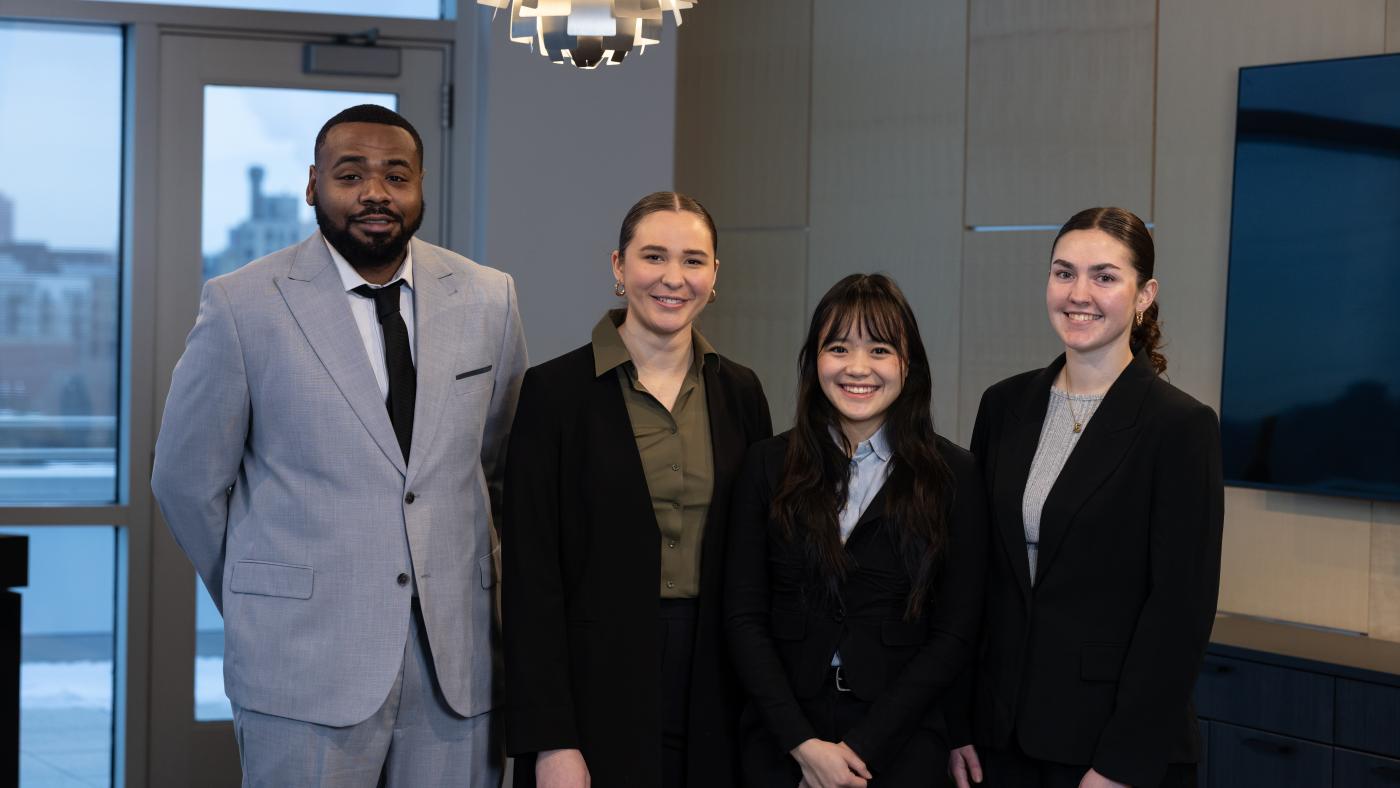
Four Hamline University undergraduate students participated in the 2025-26 Innovation Scholars Program, a hands-on opportunity combining business, science and health care entrepreneurship.
The project officially kicked off in late October, giving a team of students from diverse majors several months to tackle real-world health care challenges. They presented their findings Feb. 24, to Cantata Health, a Minneapolis company that designs platforms to support behavioral health care and human service providers, including tools to improve access to mental health and substance use disorder services.
The team included Nevaeh Barnd, ’27, exercise science and neuroscience, minor in business; Elizabeth Lopata, ’26, neuroscience, minor in public health; Vanessa Pham, ’27, business analytics and economics; and Austin Schloeder, ’26, finance.
The students were guided by Charles Primas, an MBA student from the University of St. Thomas, with mentorship from Josh Beverly, assistant professor of business analytics, Samantha Snyder Cakir, assistant professor of economics, and Lifeng Dong, physics professor.
“This project is kind of like a consulting gig,” Snyder Cakir said. “The students are expected to give recommendations, evaluate a medical innovation and consider its market potential.”
The experience challenged students to coordinate across disciplines, manage deadlines, and work independently. Pham said the program gave her a chance to apply classroom concepts to real-world health care challenges and explore her interest in the business side of healthcare.
This is the second year Hamline has participated, providing students rare opportunities to gain experience in medical innovation, entrepreneurship and market analysis before graduation.
The Innovation Scholars program is nationally recognized for giving liberal arts students experience in turning research ideas into real-world health care solutions. Sponsors include the Mayo Clinic, early-stage biomedical and health care companies and NASA.
In a Q&A, Pham reflected on her experience, sharing what she learned and the skills she gained.
What drew you to participate in the Innovations Scholar program?
I was initially inspired to apply after hearing that the first Hamline group of Innovation Scholars had the opportunity to work with the Mayo Clinic and collaborate with students from different majors. After learning more about the program from Professor Samantha, I realized it would be a great opportunity to explore potential career paths. Before joining the program, I did not have a specific field in mind, but through this experience, I became more interested in the business side of health care.
What was the biggest challenge for you in this experience?
One of the biggest challenges for me was the broad scope of the project and determining how to begin. Because the project did not follow a strict structure, I had to recall many of the concepts I had learned in class and decide which ones were most relevant to apply. Additionally, since our group consisted of four members, it was sometimes challenging to ensure that the final product sounded cohesive and unified. As a result, we frequently revisited and restructured parts of the project.
What skills did you develop or strengthen during the four month project?
This experience strengthened my ability to data-mine, visualize and analyze data, particularly in situations where there was no single “correct answer expected by a professor." I had to trust my understanding of the material and apply what I had learned, with support from the Hamline faculty. It was especially rewarding to see how concepts from the classroom could be applied to real organizations and their strategic planning.
How did working in a multidisciplinary team shape your learning experience?
The program also shaped my learning experience by giving me the opportunity to work closely with a diverse team. It was valuable to collaborate and learn from one another. I especially enjoyed learning about the areas Ellie and Nevaeh explored, which related more closely to their majors. While those topics were initially less familiar to me, they became much clearer through our discussions. In return, Austin and I were able to share more of the business-focused aspects of the project. During challenging moments, it was reassuring to have teammates to rely on and support one another.
How did it feel to work on a real-world project that could potentially impact people's lives?
As we progressed and became more deeply involved in the project, it began to feel more meaningful knowing that our work could potentially impact real organizations and individuals beyond the classroom. Listening to presentations from students at other schools was also inspiring. It was exciting to realize that the projects we worked on could contribute to discovering new insights and supporting innovation in the future.
What was the presentation like?
The presentation itself was somewhat nerve-wracking for me because public speaking is still an area I am working to improve. What made this presentation different was the need to ensure that my portion was clear, concise, and well-connected to the rest of the presentation. I wanted to highlight the key points effectively without over explaining.
What will you take away from this experience?
One of the biggest takeaways from this experience was learning how to manage a project with many moving parts. I am used to group projects where tasks can be completed independently, but this project required waiting for certain information before moving forward. I learned the importance of finding ways to contribute or support other parts of the project while waiting for the necessary information to still be productive during those times. It also emphasized the value of completing tasks early whenever possible to allow time for revisions. Revising several sections later in the process made it feel like we were falling behind schedule.
What was your favorite part of this experience?
My favorite part of the experience was seeing our project come together. I also enjoyed collaborating with my teammates and faculty members, as well as learning about the projects presented by other schools.