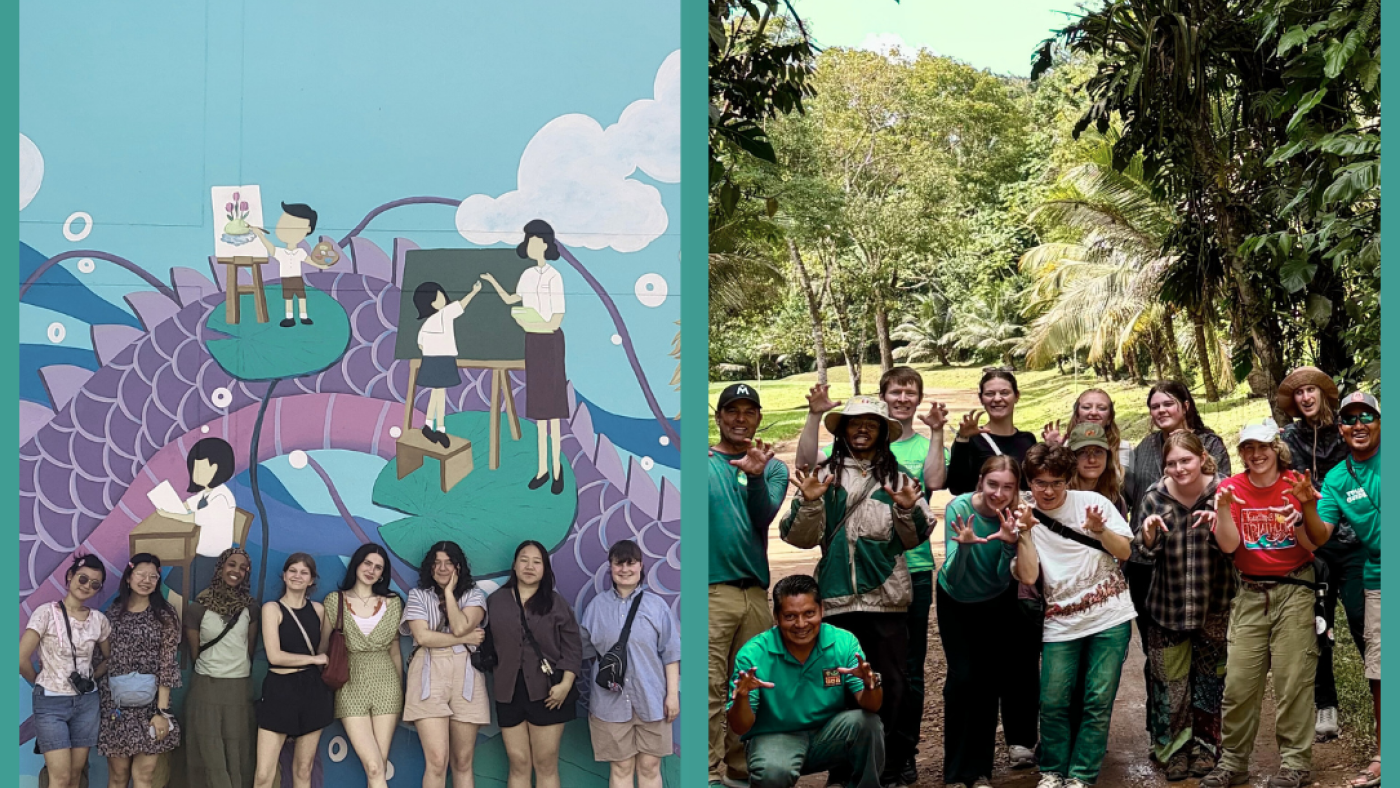
This winter, Hamline University students traveled abroad to explore culture, ecosystems and local communities during a two-week pilot study-away program in Thailand and Belize.
These pilot programs gave students the opportunity to learn through real-world experiences while making a real impact abroad. One group traveled to Thailand to explore tourism’s social and environmental effects and worked with local communities. Another group engaged in hands-on research in Belize. Experiences like these help Hamline students develop leadership, critical thinking skills and a deeper understanding of other cultures.
Cross-communication in Thailand
Eight undergraduate students who were enrolled in GIST 3980: Cross-Cultural Communication traveled to Bangkok and Phuket with English and communication studies professor Suda Ishida. A native of Thailand and a former investigative journalist, Ishida designed the course to challenge students to think critically about tourism and examine the social realities of popular vacation destinations.
“When we travel, we often see things as enjoyment,” Ishida said. “But in this course, students were able to critically examine issues in the tourism industry.”
Students visited cultural and historical landmarks including the Grand Palace, Ayutthaya, Thailand’s former capital, Old Town and the Big Buddha statue. They taught English to schoolchildren and met with members of the Chao Lay, an indigenous sea-nomadic fishing community. They learned about land-right disputes, environmental degradation and limited access to social services.
Students asked questions like, “What happened to the indigenous people and native people who lived here for centuries?,” Ishida said. “As a tourist, you never think about that at all.”
Zoya Darouie, ’26, a senior majoring in English and communication studies and minoring in education, said visiting the palace highlighted the stark contrast between wealth and poverty that she saw in the city.
“It was insanely breathtaking with such intricate details, huge architecture and over-the-top materials,” Darouie said. “The contrast between that and the citizens of Thailand who live in poverty or impoverished areas was striking.”
Interacting directly with local communities made the experience more meaningful than traditional travel, Darouie said.
“It was humanizing to be able to hear from people who are actively facing struggles in their communities,” she said. “It’s fairly common that we distance ourselves from people in different situations than us, which can lead to the dehumanization of groups of people.”
For Hanan Abdi, ’26, a senior majoring in biochemistry, English and communication studies, the program reshaped how she viewed her role as a visitor in another country.
“When we first got to Bangkok we were acting like tourists. We were gawking at everything, which is fair – that’s how people act when they visit somewhere new,” Abdi said. “But we weren’t mindful of what the villagers were going through.”
That perspective shifted after volunteering and seeing the impact of tourism on local communities.
“After volunteering at the beach cleanup and seeing the damage that the tourist industry has on people, I think we started sort of looking sideways at tourists and ourselves,” Abdi said.
Back on campus, students began working on an action plan tied to the course. Abdi said the class hopes to organize fundraising efforts and raise awareness to support the Thai communities they partnered with during the program.
“It made me want to put more effort into giving back through physical action, not just monetary action,” she said. “And to keep putting myself in situations that feel uncomfortable, because that’s where the learning happens.”
Ecology and conservation in Belize
Meanwhile, more than 10,000 miles away, another group of Hamline University students spent their winter term in Belize for BIOL 3980: Tropical Ecology and Conservation Biology, led by biology professor Leif Hembre.
The course paired a two-credit fall seminar with a two-credit field experience, allowing students to apply classroom knowledge directly to tropical ecosystems.
“Students already had some background in several of the topics we were exploring, like ecosystems and local species,” Hembre said.
Students explored tropical forests, streams, rivers and caves on the mainland of Belize, and coral reefs, seagrass beds and coastal mangrove forests while on Tobacco Caye, a small island along the Mesoamerican Barrier Reef. Working in small teams, they developed research questions and conducted short field studies with guidance from Hembre and the local marine staff.
“They learned how mangroves, seagrass areas and coral reefs are all connected,” Hembre said, “and how each part supports local wildlife, like manatees and young fish.”
In addition to their field research, students explored the history and culture of Belize by visiting Cockscomb Basin Wildlife Sanctuary and the Xunantunich Mayan ruins.
“On the last night in Belize, our group visited the Belize Zoo for a night tour where we saw tapir tracks in Monkey Bay and Cockscomb Basin and could match them to the animals,” said Lauren Moorhouse, ’28, who is double-majoring in business and psychology. “Being immersed in a foreign country is life-changing.”
Moorhouse said the trip was inspired by her aunt, who had spent a semester in Belize and still talks about the experience today.
Students kept journals reflecting on the places they visited and the people they met.
“It was common for them to write about how amazing it was to actually live the experiences they had only read about,” said faculty leader Hembre.
“Our cave-tubing excursion was one of the most captivating adventures I’ve ever been on,” Moorhouse said. “The clear, turquoise water and caves with Maya artifacts made the last event of our trip unforgettable.”