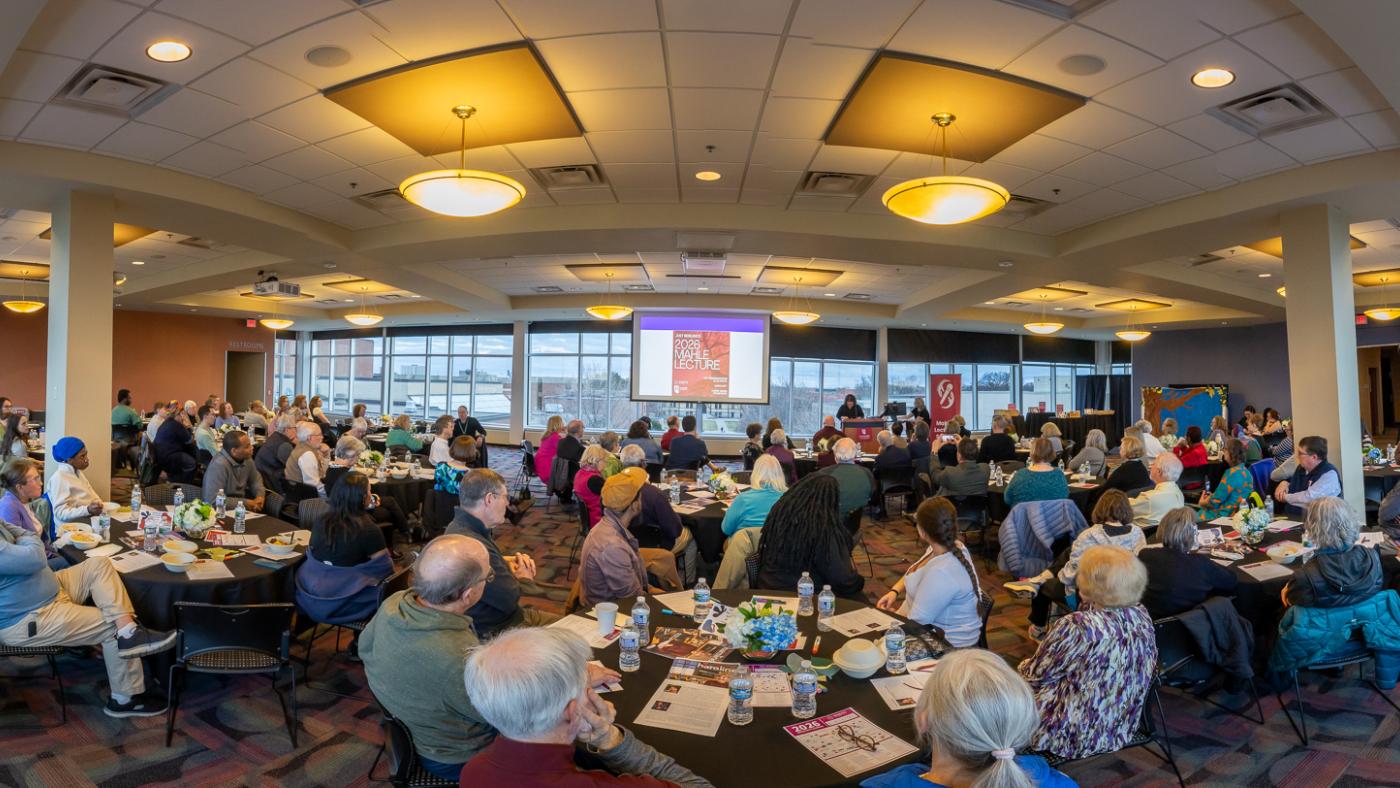
At the 2026 Mahle Lecture Friday, speakers Sara Liegl, director of Project Home and Reverend Rachel McIver Morey, director of community and engagement at Interfaith Action, said to a sold out crowd that faith communities are key to addressing family homelessness.
Modern family homelessness didn’t emerge as a widespread crisis until the early 1980s, Liegl said. She attributes it to decades of policy changes, rising housing costs and economic pressures. A shortage of affordable housing, limited access to childcare and the growing gap between wages and the cost of living made it increasingly difficult for families to achieve stability.
“The faith community really has been the driver of some very significant forward movement in housing justice work,” Liegl said.
Faith communities began stepping in to fill the gaps through direct support, as family homelessness grew. They staffed shelters, served meals and assisted families with immediate needs, showing how persistent, long-term action can make a difference.
“When the faith community commits to serving and helping in various spaces, they learn to get to know their neighbors, who happen to be unhoused and they start understanding the deep reasoning,” Liegl said. “They start seeing how all the pieces fit together.”
Liegl, who has spent 30 years working in homelessness prevention and family service, has seen how service work can spark justice efforts, empowering people to raise their voices to push for systemic change.
A concrete example of that forward faith-driven-movement is the Project Home initiative, which provides emergency shelter and 24/7 support for area families in crisis. In 2021, the organization expanded its shelter near St. Catherine University and had to secure the necessary city and county permits.
“The faith community and other community members came out in droves. We were told it was the largest, county and city zoning meeting they had ever had.” Liegl said.
The lecture also featured an interactive element: a large wall piece shaped like a tree, where participants wrote messages of affirmation, joy and hope on paper leaves. The artwork will be installed in Project Home’s multifaith room.
Morey said faith communities contribute more than time and resources, they offer stories, traditions and moral perspectives that help make sense of complex issues.
“That story gives context and meaning to the trauma of homelessness,” Morey said.
Liegl encouraged participants to take what they learned into their own lives.
“The battle isn’t over, but we can do this. Look at what’s been accomplished, and let that fuel you to take the next step,” she said.